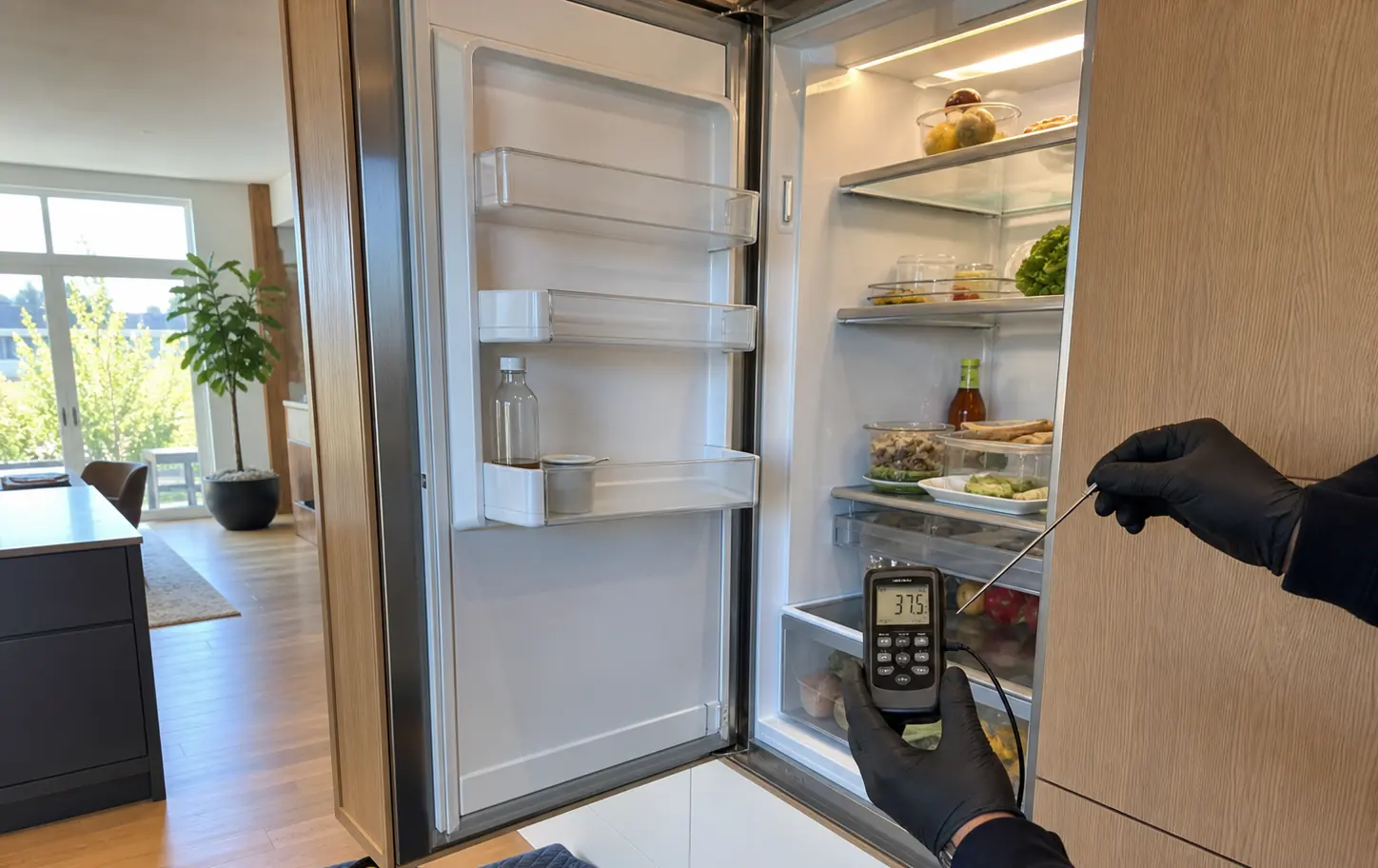
Soft ice cream, a frost slab creeping across the back wall, or a freezer drifting warm while the refrigerator stays perfectly cold — each of these reads differently on a Sub-Zero than it would on an ordinary fridge, because a Sub-Zero built-in runs two separate cooling systems. That design is the key to the whole diagnosis: it usually tells us the freezer's own circuit is at fault, not the entire machine. Here is how we triage a warm freezer in Redwood City.
An ordinary refrigerator makes cold in the freezer and lets a little of it drift up to the fresh-food side. A Sub-Zero built-in does not work that way. It carries two independent sealed systems — one tuned for the freezer, one for the refrigerator — so each compartment holds its own humidity and temperature. When customers in Redwood City call to say the freezer is warm but the fridge is fine, that split is the most useful clue we get. It means the problem lives in the freezer's evaporator, its fan, its defrost circuit or a frost-blocked coil, and it lets us skip the whole-unit hunt and go straight to the right half of the machine.
The opposite pattern — both compartments warming together — usually points at something shared, like a badly fouled condenser, a control issue, or low charge in one system dragging on performance. Either way, the first thing we do on site is confirm which compartments are holding and which are not, with real readings rather than a hand held to the air.
Likely causes
What makes a Sub-Zero freezer drift warm
A stalled evaporator fan
The freezer's evaporator fan blows cold air across the coil and through the compartment. If its bearing seizes or it ices up, the coil stays cold but the cold never reaches the food — so the freezer warms while the compressor keeps running. This is one of the most common warm-freezer faults we find.
A defrost cycle that has quit
Every freezer makes a little frost; the defrost heater and thermistor melt it away on a cycle. When that circuit fails, frost grows into a slab that blocks the coil and the vents, choking airflow. The classic sign is a heavy ice build-up on the back wall paired with a slowly warming compartment.
A door seal letting humid air in
A gasket that has stiffened or pulled away at a corner lets Redwood City's humid air leak in, where it condenses and frosts. The system then fights a constant moisture load. Drawer-style freezers are especially sensitive, and overfilling that pins the gasket open makes it worse.
A fouled condenser on a hot day
A dust- and pollen-loaded condenser can no longer shed heat efficiently, and on a warm Farm Hill or Edgewood afternoon that is sometimes enough to let the freezer slip. It is the cheapest cause, so we check and clean it first before naming any part.
Why it happens here
Redwood City conditions behind a warm freezer
Bayside humidity
The flats around Redwood Shores and Bair Island sit in damper, salt-touched air off the bay. More humidity reaching the freezer means frost rebuilds faster, so a marginal defrost circuit or a soft gasket shows up sooner there than in the dry hills.
Hot-side load
Warm, dry summer afternoons on the Farm Hill and Edgewood reaches push both sealed systems to run long. A freezer that is borderline for any reason is most likely to drift in that late-day heat.
Estate units served from town
We also cover the larger built-ins and standalone freezer columns in nearby Atherton and Woodside estates. Those high-capacity units defrost and circulate differently, and their size makes a frost-blocked coil slower to reveal itself.
Long-tenured appliances
Plenty of Mount Carmel and Friendly Acres kitchens still run older built-ins whose defrost heaters and fan motors are simply near the end of their service life — the most common honest answer to "why now."
Before we arrive
Four checks to triage the freezer yourself
Take a real freezer reading, not a guess. Set a glass of water with a thermometer on the freezer floor, or read the unit's own display if it shows the freezer column. A healthy Sub-Zero freezer holds near 0°F. Knowing whether you are at 5°F, 15°F or 25°F tells us instantly whether this is a slow drift or a near-total loss of cooling.
Check the fresh-food side at the same time. Note whether the refrigerator compartment is still cold. A warm freezer with a perfectly cold fridge is the classic dual-refrigeration signature and points straight at the freezer's own evaporator, fan or defrost circuit — not the whole machine. If both compartments are warming together, that is a different and usually more urgent branch.
Look for frost where there should not be any. Open the freezer and look at the back wall and the vents. A heavy slab of frost on the rear panel, or vents glazed shut, means the defrost cycle is not clearing — the unit makes cold but then chokes its own airflow. In the bayside humidity around Redwood Shores and Bair Island, that frost rebuilds faster than owners expect.
Test the door seal with a slip of paper. Close the freezer drawer or door on a strip of paper and tug. If it slides out with little resistance anywhere along the edge, the gasket is no longer sealing, and humid Redwood City air is being pulled in to frost up and overload the system. Note where it is loose so we can match the right gasket profile by model.
We are an independent Sub-Zero and Wolf repair service in Redwood City — not affiliated with or authorized by Sub-Zero — and we work by phone and online booking only, with no contact form and no email.
FAQ
Warm-freezer questions from Redwood City owners
My Sub-Zero freezer is warm but the refrigerator is still cold — how is that possible?
It is possible because a Sub-Zero built-in uses dual refrigeration: two separate sealed systems, one dedicated to the freezer and one to the fresh-food side. When the freezer drifts warm while the fridge stays perfectly cold, the fault is almost always inside the freezer's own circuit — its evaporator fan, defrost heater, thermistor or a frost-blocked coil — rather than a whole-unit failure. That separation is good news: it narrows the repair considerably.
Why does frost keep building up in my freezer in Redwood City?
Frost is moisture that got in and never got cleared. It gets in through a tired door gasket or frequent openings, and it fails to clear when the automatic defrost cycle is not working — a failed defrost heater, a bad defrost thermistor, or a control fault. Homes in the damper bayside areas like Redwood Shores see frost rebuild faster because the incoming air carries more humidity for the system to deal with.
Is soft ice cream a real warning sign or am I overreacting?
It is a real early sign. Ice cream sits at the temperature edge where a few degrees of drift shows up first, so soft ice cream while everything still looks frozen often means the freezer has crept from 0°F up into the teens. Catching it there — before the food actually thaws — usually means a smaller repair, often a fan or a defrost component rather than anything in the sealed system.
Does the type of Sub-Zero I have change the diagnosis?
It does. A classic over-under or side-by-side built-in, a dedicated freezer column, and an undercounter freezer drawer each route their airflow and defrost differently, and parts are model-specific. Drawer units, for example, are sensitive to overfilling that blocks the vent. Telling us whether you have a column, a side-by-side or a drawer — plus the model number — lets us bring the right parts the first time.
Could the warm freezer just be a dirty condenser?
Sometimes, yes. A condenser packed with dust and pet hair — common in tree-shaded Farm Hill and Edgewood-area homes — makes both sealed systems work harder, and on a hot afternoon that can be enough to let the freezer drift. We always check and clean the condenser as part of the diagnosis, because it is the cheapest possible cause and worth ruling out before any part is named.
How urgent is a warm Sub-Zero freezer?
It depends on the reading. A freezer at 5-10°F with food still frozen is worth a prompt appointment but not a panic; keep the door closed and book a visit. A freezer climbing past the teens with food softening is more urgent — move what you can to another freezer and call so we can prioritize the route. Either way the $89 diagnostic is credited toward the repair once approved.