Sub-Zero making a loud or unusual noise in Redwood City
A built-in Sub-Zero is not a silent appliance. Two compressors and two fans mean it makes more baseline sound than an ordinary refrigerator, so the question is rarely "is it making noise" and almost always "is this a new noise." Buzzing, humming, rattling, clicking and grinding each point somewhere different. Below is how we read the sound from your Redwood City kitchen — and which ones mean a part is failing.
Start by deciding whether the sound is new. A Sub-Zero that has always hummed softly and now hums softly needs nothing. A unit that has picked up a buzz, a grind or a rattle over the last week or two is telling you something has shifted — usually a fan, a dusty condenser, or a unit knocked off level. The five sounds below cover almost every noise call we take across Redwood City.
Sound decoder
What each Sub-Zero noise usually means
A low hum that never stops
A built-in Sub-Zero runs two sealed systems, so a soft, continuous hum is simply the compressors holding temperature — especially through a warm Redwood City afternoon when they cycle longer. It is only worth a call when the hum climbs to a strain or is joined by a new vibration you can feel through the cabinet.
Buzzing that rises and falls
A buzz that swells, eases, then swells again usually traces to a fan blade clipping frost, a bent shroud, or a fan motor whose bearings are starting to go. In tightly built older kitchens around Mount Carmel and Friendly Acres, where the unit sits snug in millwork, that buzz reflects off the cabinetry and sounds far worse than the fault behind it.
Rattling or a loose vibration
Rattles are most often something simple: a drip pan that has shifted, a loose lower grille, or a unit that has drifted off level after a floor refinish. They can also be a condenser fan loaded with dust spinning slightly out of balance. We rule out the cheap causes before anyone opens the sealed system.
Clicking on a cycle
A periodic click is usually a relay, a defrost timer, or the ice maker beginning a harvest — all normal. A rapid click-click-click that repeats without the compressor catching is different: it points to a start relay or an overload on the compressor and is worth catching early before the compressor itself is stressed.
Grinding, scraping or a metallic whir
This is the sound to act on. Grinding or a hard metallic whir means a fan motor's bearing has failed, a blade is striking ice, or the evaporator fan is dragging. Left alone it can stall the fan entirely, which then shows up as a warming compartment — so a noise call here often heads off a no-cooling call next week.
Why Redwood City units get loud
Local reasons a built-in starts making noise here
Tree debris
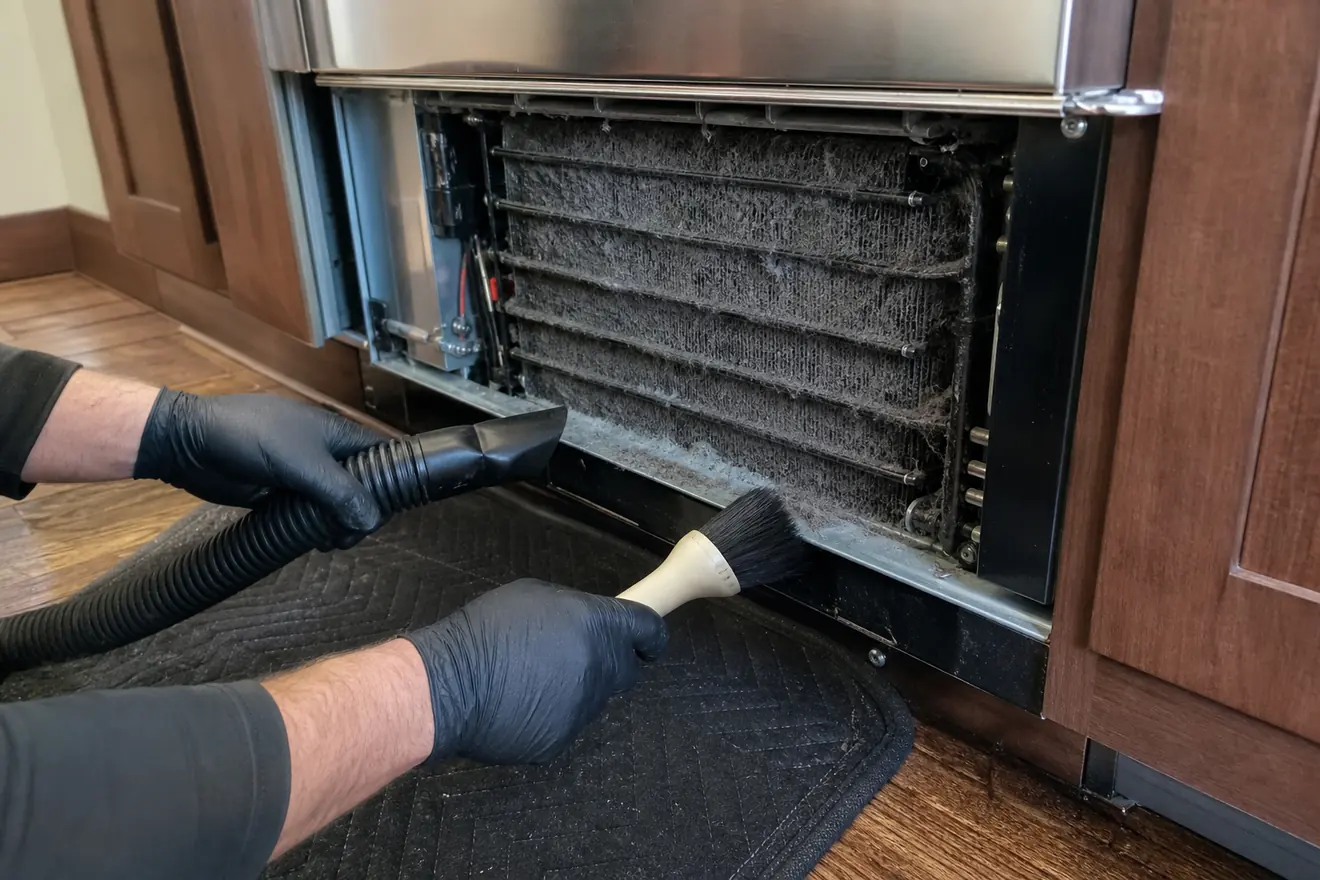
The mature canopy over Farm Hill and Woodside Plaza drops fine pollen and leaf litter that, with household pet hair, mats onto the condenser coil and unbalances the fan. A loaded coil is the single most common reason a quiet unit turns loud here.
Older installs
Many Mount Carmel and Friendly Acres homes still run built-ins boxed into original 1950s cabinetry. The tight enclosure reflects fan and compressor sound, so a minor fault can read as an alarming racket until you separate the noise from the cabinet.
Refinished floors
Remodeled Emerald Hills and downtown kitchens are often re-floored, and a unit set back a hair off level afterward will rattle or buzz against the adjoining millwork. Re-leveling alone resolves a surprising share of rattle calls.
Long summer cycles
Warm "Climate Best" afternoons make both compressors run longer, so any developing fan or bearing noise is most audible in the late-day heat — which is exactly when owners tend to notice and call.
Before we arrive
Four checks to locate the noise yourself
Pin down which compartment the sound comes from. Open the fresh-food door, then the freezer, and listen with each open and closed. A noise that grows when the freezer is open points at the evaporator fan inside; one that is loudest down low at the front, with the doors shut, points at the condenser fan behind the lower grille.
Pull the lower grille and look at the condenser. Slide the kick plate off and shine a light on the condenser coil and fan. In Farm Hill and Woodside Plaza homes shaded by mature trees, that coil packs with pollen, lint and pet hair faster than owners expect, and a dust-loaded fan runs loud and out of balance. A careful vacuum here quiets many units on its own.
Check that the unit still sits level and solid. Press gently on the front corners. If the cabinet rocks or a panel buzzes against adjacent millwork, the unit has drifted off level — common after a kitchen floor is refinished, which happens a lot in remodeled Emerald Hills and downtown homes. Re-leveling the legs often ends a rattle without any part at all.
Note when the sound happens. Write down whether the noise is constant, tied to the defrost cycle, or only during an ice harvest. That timing tells us whether to bring an evaporator fan, a condenser fan, or to look at the ice maker and relays first — so the right part rides along on the first visit.
FAQ
Noise questions from Redwood City owners
Is it normal for a Sub-Zero to be louder than my old refrigerator?
A built-in Sub-Zero runs two independent sealed systems and two fans, so it makes more baseline sound than a basic top-freezer unit — a steady hum and the occasional whoosh of a fan are normal. What is not normal is a new sound: a grind, a rising buzz, a hard rattle, or a hum that has clearly grown louder over a week or two. Those are worth a look.
Why did my Sub-Zero suddenly get loud after years of being quiet?
The most common reason in Redwood City is a condenser that has slowly packed with dust, pollen and pet hair until the fan can no longer spin cleanly. Homes shaded by the big trees in Farm Hill and around Woodside Plaza load that coil fastest. The next most common is a fan-motor bearing reaching the end of its life, which announces itself as a buzz or grind that worsens gradually.
Can a noisy Sub-Zero turn into a unit that stops cooling?
Yes, and that is the reason not to ignore a grinding or dragging fan. The evaporator fan moves cold air through the compartments; if its bearing seizes, airflow stops and the fresh-food side warms even though the compressor is fine. Addressing the noise early usually prevents that second, more urgent failure.
My older built-in in Mount Carmel sounds worse than the noise itself seems — why?
Many 1950s Mount Carmel and Friendly Acres kitchens have the refrigerator boxed tightly into original cabinetry, and those snug enclosures reflect and amplify fan and compressor noise. The actual fault may be small, but the cabinet acts like a sounding board. We check the install and clearances along with the mechanical parts.
Should I unplug a Sub-Zero that is making a loud noise?
Only if you hear a hard grinding or smell anything hot — in that case unplug it and call. For a buzz, rattle or hum the unit is safe to keep running while you book a visit, and keeping it cold protects your food. If a rapid clicking repeats without the compressor starting, it is best to book promptly so the start components are checked.
Describe the sound — buzz, rattle, grind or click — and when it happens, and you will get a clear price before any work begins. We are an independent repair service, not affiliated with or authorized by Sub-Zero.