
How-to guide · 7 min read
Clearing a clogged Sub-Zero defrost drain in Redwood City
A frozen or scaled-up defrost drain is the quiet cause behind a puddle and a sheet of ice in a Redwood City Sub-Zero. Why hard water makes it a repeat problem here, the signs to watch, and how to clear it safely.
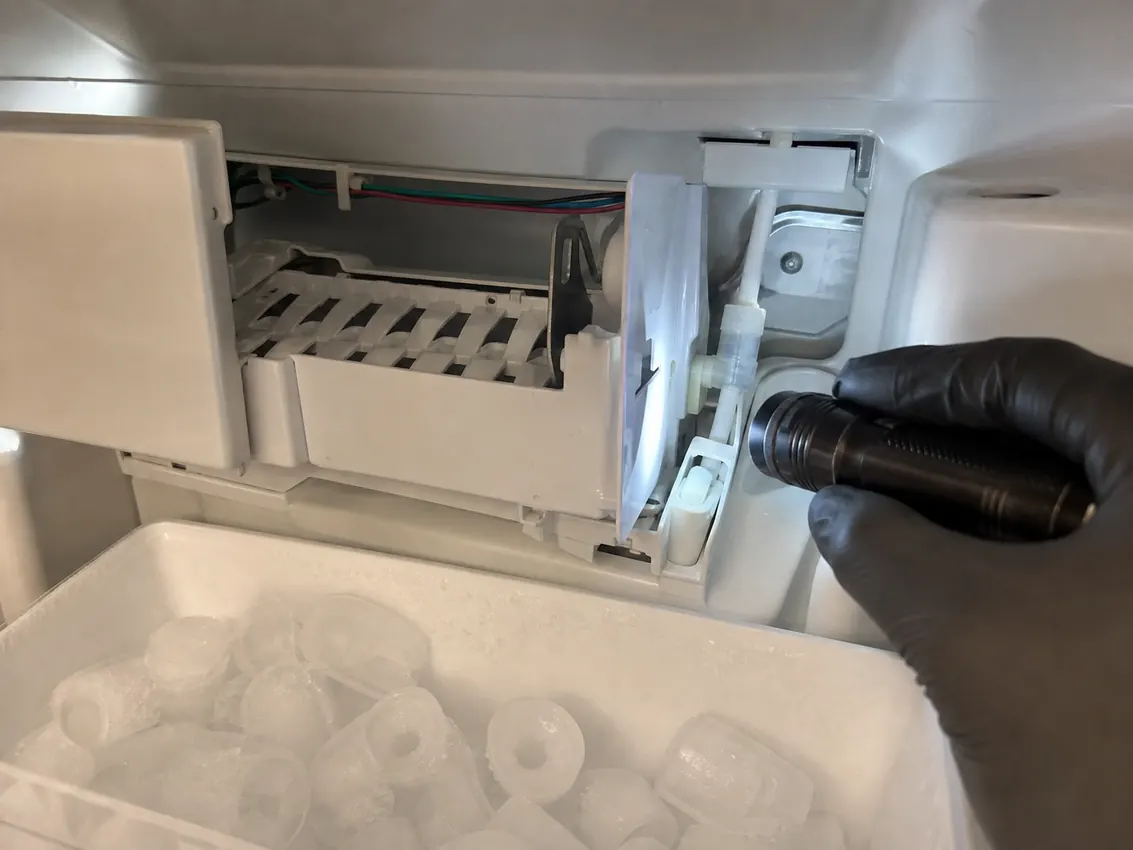
If a Sub-Zero is leaving water on your Redwood City floor and a sheet of ice on the freezer floor at the same time, there is a good chance the two share one cause: a defrost drain that has stopped draining. It is one of the most common service calls we take across the Peninsula, and in Redwood City it has a local twist — the mineral content in our water tends to turn a one-time clog into a problem that comes back.
This guide walks through what the defrost drain actually does, why it clogs, the signs that point to it specifically, and how to clear it safely yourself. It pairs closely with our broader page on a Sub-Zero leaking water onto the floor, which covers the other leak sources; here we go deep on just the drain.
What the defrost drain does, in plain terms
Every built-in freezer makes a little frost on its evaporator coil. On a cycle, a small heater warms the coil just enough to melt that frost, and the meltwater runs down a narrow channel and a short tube into a pan beneath the cabinet, where it harmlessly evaporates. The whole system depends on that thin drain path staying open. When it blocks, the melt has nowhere to go: it refreezes into a slab on the freezer floor, and once that slab overruns the channel, the excess spills forward and out onto your kitchen tile or hardwood.
Why Redwood City water makes this a repeat problem
Here is the local part. Redwood City's tap water runs moderately hard, carrying enough dissolved mineral that, over time, it leaves a fine chalky scale wherever it sits and dries. Inside a Sub-Zero, that scale builds in two places that matter: the ice-maker's fill path and the defrost drain channel. A drain that is even slightly scaled has a smaller opening, so it ices shut sooner and re-clogs faster after a simple clearing. That is why owners in the same home sometimes call us twice in a couple of years for what looks like the same leak — the debris was cleared, but the underlying scale narrowed the channel again. The durable fix is to flush the line, not just poke the plug, and on repeat offenders to check whether the small drain heater that is meant to keep the path open has weakened.
The signs that point to the drain specifically
A few clues separate a drain clog from the other reasons a Sub-Zero leaks. First, the puddle tends to return on a rhythm — every several hours, tracking the defrost cycle — rather than as a constant trickle, which would suggest a supply line instead. Second, you will usually find ice where it does not belong: a flat sheet on the freezer floor, or frost creeping out from the back corner. Third, the water is clean and odorless; it is condensate, not anything from the food. If you see that combination — rhythmic puddle, floor ice, clean water — the drain is the prime suspect.
Clearing it safely, step by step
Start by emptying the lower freezer basket and removing the slab of ice you can reach by hand; do not chip at it with a knife or screwdriver near the coil, which is easy to puncture. Next, let the ice melt naturally — either power the unit down for a few hours with the door open and towels down, or use a hair dryer on low held well back from any plastic. Once the floor is clear, find the small drain opening at the back of the freezer floor and gently flush it with warm — not hot — water using a turkey baster or a soft bulb syringe; you are dissolving scale and pushing the plug down toward the pan, not forcing it. If warm water passes freely and the floor stays dry over the next day or two, you have likely solved it.
When it is past a home fix
Call for service if the drain re-clogs within weeks, if warm water will not pass at all, or if you see frost rebuilding heavily even after the floor is clear. Those point beyond a simple plug — usually a failed defrost heater or thermistor letting the coil over-frost, or a drain heater that no longer keeps the path thawed. We test the defrost heater, the thermistor and the drain together so the repair addresses the cause, then flush the line to clear the scale that our water leaves behind. We are an independent Sub-Zero and Wolf service in Redwood City, not affiliated with or authorized by Sub-Zero, and we run phone-and-booking only — no email form to chase. Bring the model and serial off the inside frame and we will arrive ready.
FAQ
Questions & answers
Can I really clear a Sub-Zero defrost drain myself?
Often, yes — if the cause is a simple ice plug. Remove the reachable ice by hand, let the rest melt, then flush the drain opening at the back of the freezer floor with warm water and a baster. What you should not do is chip at ice near the coil or pour boiling water in. If it re-clogs quickly, that is a sign the drain heater or defrost circuit needs a professional look.
Why does my Redwood City Sub-Zero drain keep clogging after I clear it?
Our local water is moderately hard, and the mineral scale it leaves slowly narrows the thin defrost drain channel. A narrower channel ices shut sooner, so the same leak returns. Flushing the line to remove scale — rather than just clearing the visible plug — and checking the drain heater is what makes the fix last.
Is the water from a defrost-drain clog dangerous?
No. It is clean condensate, not refrigerant or anything from the food, so there is no health hazard. The concern is the flooring: water under engineered wood or stone does quiet damage, so it is worth clearing promptly and keeping towels down until it is resolved.
How is this different from your leaking-water page?
The leaking-water page covers every source — defrost drain, ice-maker plumbing, the filter housing and door-seal condensation — and helps you tell them apart. This guide assumes the drain is the culprit and goes deep on clearing it and on why Redwood City's water makes it recur.
Rather leave it to a specialist?
Have the failing compartment and model number ready, and you will get a real first opinion — not a sales pitch.